Freeze the design reference
Use a drawing number and revision, installed section, datums and critical interfaces. Identify any controlled model/drawing differences.
REVISION CONTROL / PROTOTYPE-TO-PRODUCTION
Reduce the gaps between your drawing, the sample quotation and the acceptance test. Start a DFM review with clear installed constraints, revision-controlled files and an agreed prototype deliverable.
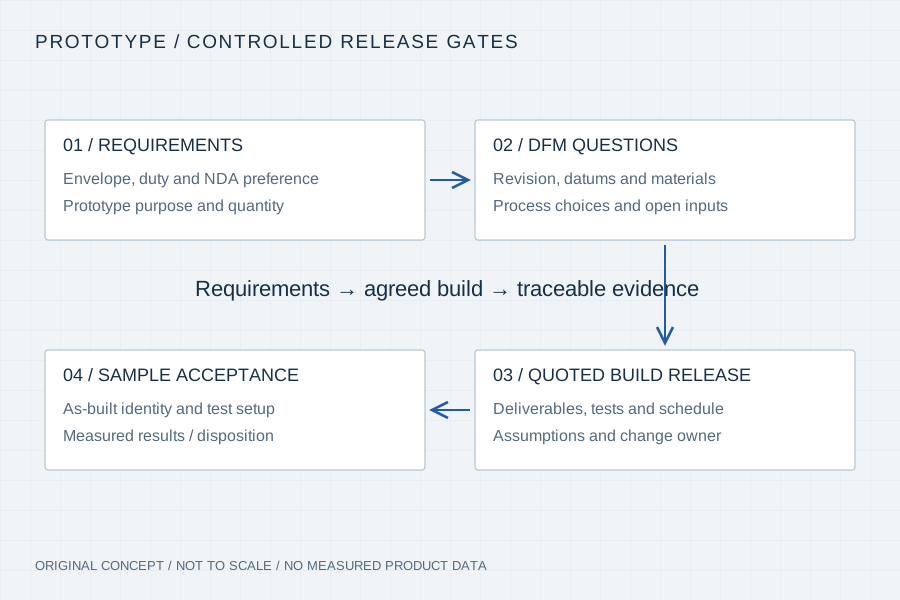
Choose what the prototype must prove: mechanical fit, electromagnetic duty, low-speed motion, thermal performance or a complete integration step. A geometry sample and a functional motor need different inputs and tests. The enquiry can begin with unknown values; the build scope should be frozen before manufacture.
Use a drawing number and revision, installed section, datums and critical interfaces. Identify any controlled model/drawing differences.
Separate fit-check parts, magnetic assemblies, functional motor kits and integrated modules, with retained customer hardware identified.
Specify tests, acceptance owner, requested date and quantity. The quotation confirms the schedule and supporting assumptions.
These gates define a working discussion, not an automatic DFM approval or a fixed response-time SLA. Requested dates remain requirements until confirmed in a quotation.
| Gate | What to provide or decide | Output to agree |
|---|---|---|
| Requirements / confidentiality | Project goal, envelope, duty, quantities and NDA preference | Open questions, authorised sharing route and review boundary |
| Drawing and process review | Revision, GD&T/datums, materials, interfaces and manufacturing constraints | DFM questions, proposed process scope, assumptions and exclusions |
| Prototype quotation / release | Sample type, supplier/material availability and test requirements | Deliverables, acceptance plan, price, schedule and change responsibility |
| Sample verification | As-built identity, setup, conditions, instruments and measured results | Traceable sample report and disposition against agreed limits |
| Production transition | Design changes, tooling, consistency and incoming/final inspection plan | Approved revision, manufacturing route and change-control agreement |
Read the installed section
A prototype route may use machined carriers or housings, suitable low-volume lamination methods, a printed winding or a supplier-supported winding/assembly process. The choice affects tolerances, surface condition, insulation, stack control and how closely the sample represents production.
A drawing review should state which processes and inspections are included, what is subcontracted and what changes for production tooling. No specific machine brand, simulation package, inspection capability or certification is implied without a project-specific supply record.
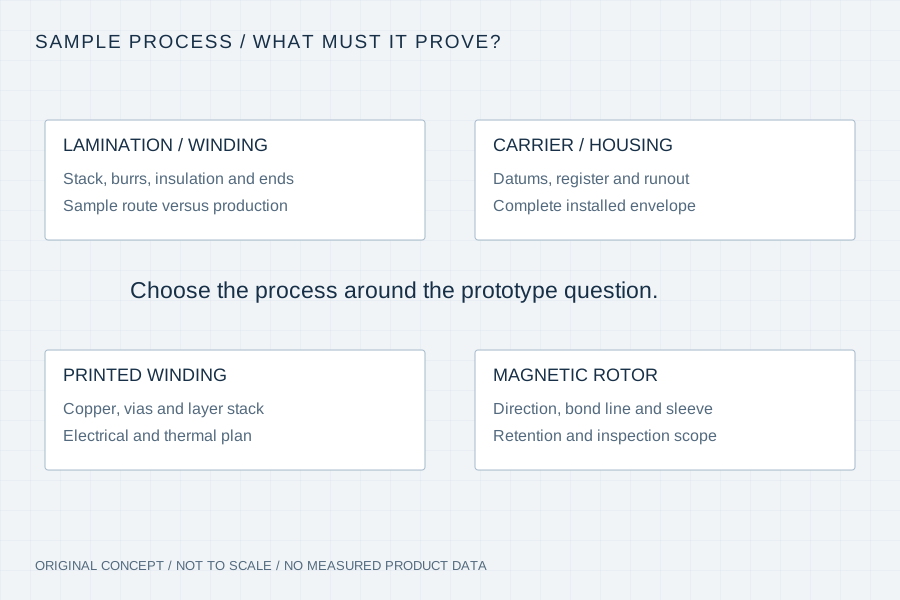
Identify the register, shaft or bore, bolt circle, mounting faces, air gap, runout and complete installed length that matter to the machine. Specify datums and measurement conditions. A tight number without an agreed datum or inspection method can leave both parties evaluating different geometry.
State how phase resistance, back-EMF constant and phase balance will be measured, including temperature, speed and connection convention. Define any insulation/withstand requirement and method for the actual design. A blank inspection plan does not establish safety approval or a passed electrical result.
Define responsibility for bearings, feedback, brake, cable exits, potting, rotor retention and the customer housing. Record what is included in the supplied sample and what must be assembled or validated by the customer. Retain the same identifiers when sample changes are incorporated into production.
01 / Review gate
Identify drawing/model revisions, material substitutions, winding configuration, sample serial or lot and any permitted deviations.
02 / Review gate
Agree dimensions, electrical checks and loaded-duty tests with units, conditions and acceptance limits before collecting results.
03 / Review gate
Record measured results, open issues and the person responsible for disposition. Production approval follows a separate reviewed release.
Use these editable CSVs to agree inputs, conditions and responsibilities. Results remain blank; they are planning aids, not certificates or completed inspection reports.
Your inputs / an actionable review
Enter known constraints or “Need advice”. Mark documents you can provide; this records availability, not file inspection or engineering approval. No document is required to start a discussion.
4 document topics to discuss. Selected documents have not been uploaded or reviewed.
Carry This Brief into the Web Inquiry ↗Your email, already structured
Use the same brief in your email client or copy it with our address. Add photos or drawings as email attachments when available.
Downloads contain your entered details and file links, including contact details when provided. Keep or share them according to your project’s confidentiality requirements. Saving a draft does not send it to us. The JSON restores the inquiry form; it is not a CAD attachment.
Your inputs remain in this page until you send the web form. If your email app omits a long message, copy the complete brief above.
No. Begin with the space envelope, application and known interfaces. List missing inputs in the review pack so the team can identify what is needed for a quotation or prototype release.
Those can be requested targets, but a committed schedule needs a defined scope, authorised files, material availability, tooling and supplier-capacity review. The accepted quotation sets the dates.
This page prepares the brief, not a local-file upload. Request an NDA and agreed transfer channel, use a controlled sharing link in the inquiry or attach authorised files to the prepared email.
No. They are blank planning templates with no measured values or pass results. Agree the methods and limits, then use a separately traceable report for the actual sample.