Assembly passage
Measure the largest connector and tooling access needed to install or replace the harness, not only the running bundle.
SURGICAL ROBOT SUBSYSTEM / MOVING SERVICE PASSAGE
Keep the service passage usable after the motor is installed. Review connector access, harness bending and rotating interfaces with the device engineer before fixing the bore and motor envelope.
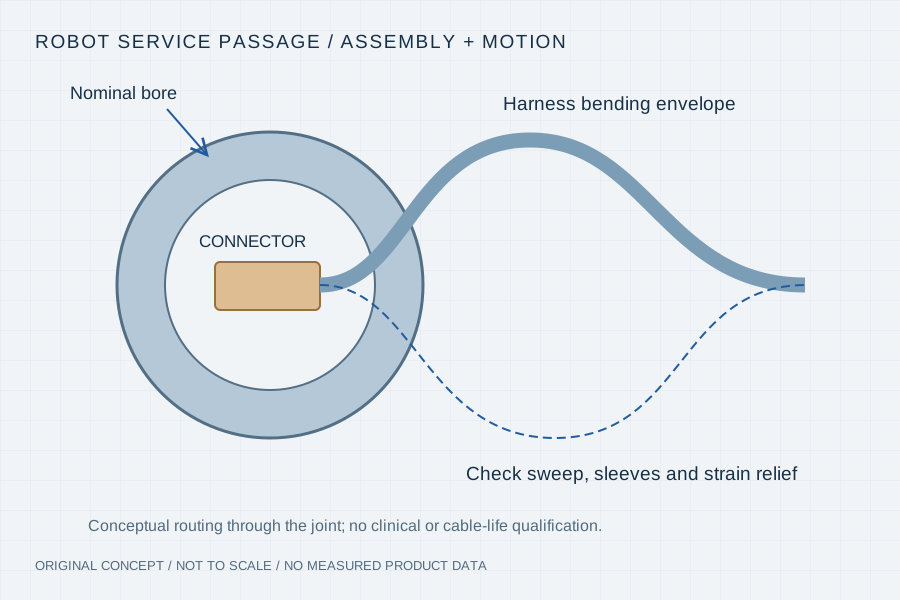
The largest connector, strain relief, protective sleeve and installation sequence can set the passage requirement before the loose cable diameter does. Joint travel can then require extra sweep and bending space. Start with the service path through the entire joint and the parts that surround it.
Measure the largest connector and tooling access needed to install or replace the harness, not only the running bundle.
State rotation range, cable bend radius, strain relief and the expected motion cycle for the complete routing design.
Identify which motor, seal, cable or cover surfaces encounter the specified cleaning or environmental conditions.
Read the installed section
A hollow-shaft or frameless arrangement can leave a central service route, but the motor bore is only one segment of it. The carrier, bearings, encoder, reducer, sleeves and cable exits can create tighter sections. The final section and assembly sequence determine which connectors and moving services pass through.
This is a component-integration enquiry for the device engineering team. The application name does not establish medical approval, sterilisation suitability or the safety of a completed system. Required materials, exposure conditions and validation responsibilities must be supplied for the actual device.
Technical context: Kollmorgen — frameless component boundaries ↗
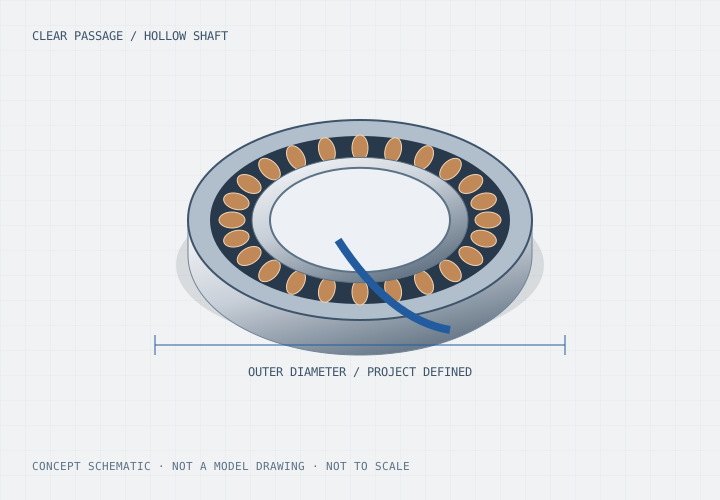
A large nominal bore is useful only when the complete assembly and routing remain compatible with the intended operation.
| Routing decision | Input to provide | What the review must resolve |
|---|---|---|
| Connector installation | Largest connector, mating/tool access and assembly sequence | Minimum passage at each interface and whether parts must be installed before closure |
| Moving harness | Bundle/sleeve, minimum bend radius, sweep and travel cycle | Clearance, strain relief and potential rubbing/twist locations |
| Rotating services | Limited versus continuous rotation, fluid/optical/electrical services | Whether cable loops, rotary unions or other interfaces are required |
| Exposure / isolation | Specified cleaning agents, temperatures, duration and affected surfaces | Material, seal and isolation scope for device-specific validation |
| Thermal and motion duty | Load cycle, speed, cooling and relevant sensor locations | Motor/drive performance and routing behaviour in the assembled joint |
List each service and its connector, sleeve, allowable bending/twisting and replacement requirements. Avoid relying on a combined nominal bundle diameter when individual services impose different constraints. The review should identify who owns the harness and any rotating interface.
A routing path can satisfy operation yet make maintenance difficult. Show access for connector mating, cable replacement, covers and strain relief. Identify interfaces that must stay fixed so the motor proposal does not assume extra disassembly space.
Provide the actual exposure boundary and requested material/process records. State whether tests apply to a bare component, a sealed module or the assembled device. A motor enquiry does not substitute for the device owner’s verification and release process.
01 / Review gate
Compare connector and harness envelopes against the motor, bearing, reducer and feedback sections in the released drawing.
02 / Review gate
Check the proposed routing through the specified travel and cycle with the harness and strain relief installed.
03 / Review gate
Agree motor duty, material/exposure evidence, inspection records and responsibility for final device validation.
Your inputs / an actionable review
Enter known constraints or “Need advice”. Mark documents you can provide; this records availability, not file inspection or engineering approval. No document is required to start a discussion.
4 document topics to discuss. Selected documents have not been uploaded or reviewed.
Carry This Brief into the Web Inquiry ↗Your email, already structured
Use the same brief in your email client or copy it with our address. Add photos or drawings as email attachments when available.
Downloads contain your entered details and file links, including contact details when provided. Keep or share them according to your project’s confidentiality requirements. Saving a draft does not send it to us. The JSON restores the inquiry form; it is not a CAD attachment.
Your inputs remain in this page until you send the web form. If your email app omits a long message, copy the complete brief above.
No. Bearings, carrier, feedback, sleeves and installation access can reduce the route. Evaluate the minimum clear passage through the complete joint.
The routing architecture must be reviewed against the requested travel and services. Continuous rotation may require a suitable rotating interface; no cable-life claim is inferred here.
No. It is a component integration guide. Device-specific exposure, materials, verification and any required approvals must be separately established.
Send the available connector and service information, travel range and provisional section. Mark unresolved service envelopes in the review brief.
Primary context for the shaft, housing, bearings and feedback outside an electromagnetic kit; no medical qualification is implied.