Magnet temperature
State continuous and transient magnet temperature separately from ambient, housing-surface and winding limits.
GANZHOU SOURCING / MAGNET-TO-ROTOR QUALIFICATION
Connect Ganzhou magnetic-material sourcing to the rotor your shallow motor needs. Define grade, diffusion geometry, magnet temperature and retention evidence before releasing a magnetic assembly.
A shallow, enclosed motor can put the magnets at a different temperature from the housing surface or winding sensor. Grade selection must account for the magnet’s actual thermal history, geometry and opposing magnetic field. A catalogue temperature label cannot establish irreversible-demagnetisation margin in every rotor.
State continuous and transient magnet temperature separately from ambient, housing-surface and winding limits.
Provide segment thickness, orientation, air gap, carrier and the reverse-field or motor load case.
Request material grade/lot records, declared hot magnetic curves and revision-linked assembly checks.
Read the installed section
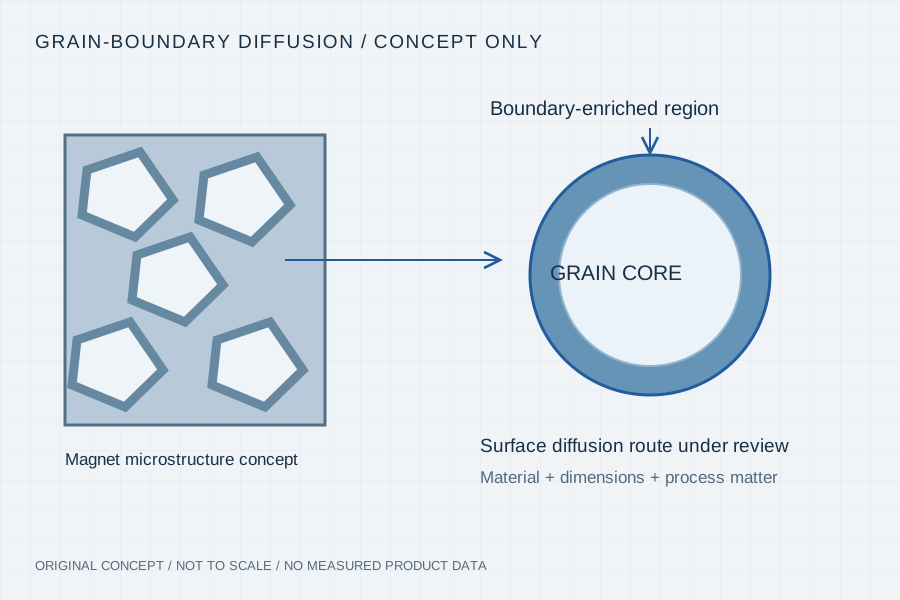
Grain-boundary diffusion introduces selected elements from a magnet surface into the boundary region of the NdFeB microstructure. It can raise coercivity while limiting the remanence penalty relative to some bulk heavy-rare-earth addition routes. The outcome depends on the starting material, dimensions and processing route.
The review should establish the actual supplier process and grade, diffusion access and geometry limits, and the measured properties of the delivered material. Our Ganzhou sourcing narrative does not establish ownership of a named producer’s process or a universal temperature or heavy-rare-earth saving.
Technical context: TDK — HAL diffusion process technical journal ↗
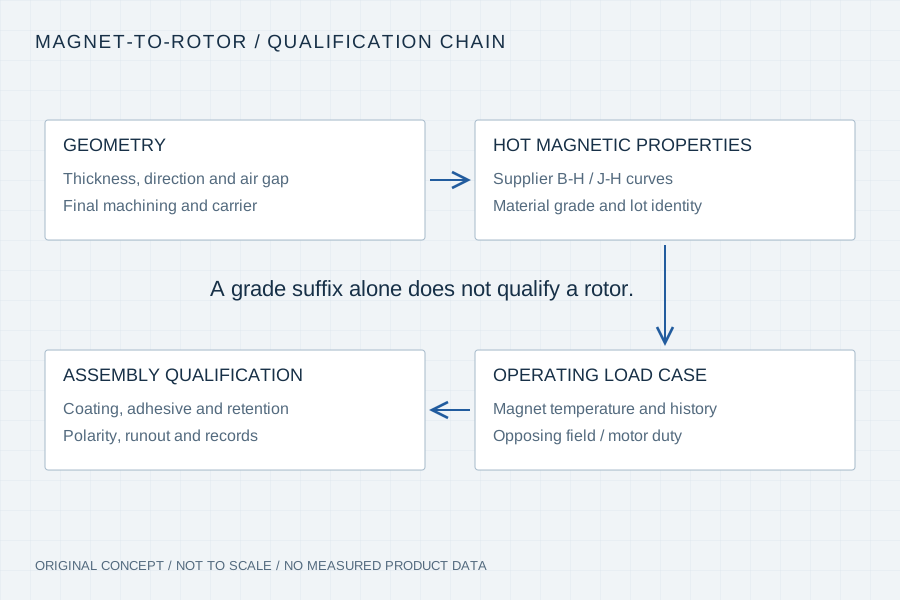
Use the table as a purchase-review checklist. It does not prescribe a safe temperature, guaranteed diffusion depth or interchangeable grade.
| Decision | Required project input | Record to request |
|---|---|---|
| Grade and thermal margin | Magnet temperature history and reverse-field/load case | Supplier B-H/J-H curves at relevant temperatures, with material/lot identity |
| Diffusion suitability | Segment dimensions, magnetisation direction and post-process machining | Supplier assessment of process/geometry limits and final magnetic properties |
| Coating and bonding | Medium, humidity, adhesive, cure temperature and surface preparation | Coating specification, bonding-process scope and agreed acceptance method |
| Loss and segmentation | Pole count, speed, drive harmonics and insulation between pieces | Loss-model assumptions and prototype temperature/loss evidence where required |
| Carrier and retention | Air gap, runout, speed, sleeve or mechanical retention | Revision-controlled inspection and retention/balance plan |
A magnetic grade does not rate the complete rotor assembly. Coating integrity, adhesive strength, carrier expansion and any retaining sleeve can impose different limits. Include storage, cure, continuous operation and short excursions when defining the material and assembly scope.
Surface access, segment thickness and machining after treatment can affect which material remains in the finished part. Ask the supplying manufacturer to qualify the chosen route for the final geometry. Avoid treating a process acronym or a room-temperature sample value as proof for every production segment.
A Halbach or multipole rotor needs a defined polarity/direction sequence, bonding datums and inspection reference. Discuss tooling, pre-magnetised handling or feasible post-assembly magnetisation with the supplier. The agreed build record should connect segment identity and direction checks to the released rotor drawing.
01 / Review gate
Agree grade, geometry, temperature/load case, coating, quantity and required source/lot documents. Confirm where each process is performed.
02 / Review gate
Freeze carrier and bond-line dimensions, segment orientation, retention and the inspection datums. Resolve material substitutions through change control.
03 / Review gate
Review the agreed magnetic/geometry records and any required retention, balance or thermal tests. A test-plan template is not a passed sample report.
Your inputs / an actionable review
Enter known constraints or “Need advice”. Mark documents you can provide; this records availability, not file inspection or engineering approval. No document is required to start a discussion.
4 document topics to discuss. Selected documents have not been uploaded or reviewed.
Carry This Brief into the Web Inquiry ↗Your email, already structured
Use the same brief in your email client or copy it with our address. Add photos or drawings as email attachments when available.
Downloads contain your entered details and file links, including contact details when provided. Keep or share them according to your project’s confidentiality requirements. Saving a draft does not send it to us. The JSON restores the inquiry form; it is not a CAD attachment.
Your inputs remain in this page until you send the web form. If your email app omits a long message, copy the complete brief above.
No. Suitability depends on the specific material, geometry, magnetic circuit, load case and temperature history. Coating, adhesive and retention limits must also be reviewed.
No. They explain the concept only. Material qualification needs supplier-specific property data and any agreed material or assembly tests.
Yes. Identify the boundary: loose magnets, bonded carrier, retention, magnetisation, balance and inspection. Each deliverable needs its own drawing and acceptance scope.
No. Supplier identity, process location, material properties and any commercial or environmental declarations must be documented for the actual order.
Primary explanation of a surface-diffusion route and coercivity/remanence considerations; it is not evidence of our supplier’s process.
Primary material guidance on geometry, grade, temperature and GBD options. Supplier values are not our assembly ratings.