Motion ripple
Specify speed, load and the measurement bandwidth.
SEMICONDUCTOR & OPTICAL
Lower the axis package while keeping velocity ripple, thermal drift and contamination requirements visible. Review slotless or coreless construction against the measurement task.
Send Us Your Space Constraints ↗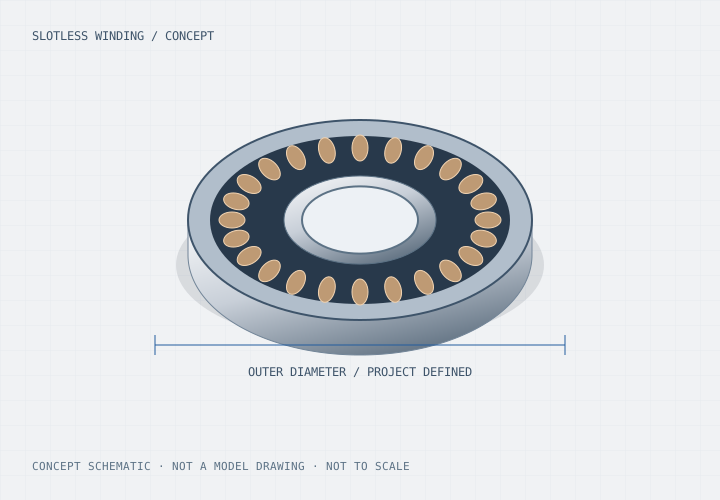
Before selecting a winding
Specify speed, load and the measurement bandwidth.
Allocate a temperature and displacement budget near the optical path.
Define material and process evidence for the actual equipment location.
Slotless and coreless arrangements can address slot-related cogging. They cannot by themselves establish positioning accuracy or settling time. Include encoder error, current-loop behavior, bearing drag and structural resonance in a complete axis assessment.
Specify lubricant, cable, adhesive, packaging and cleaning requirements where contamination matters. Vacuum compatibility and outgassing need application-specific evidence. Ask for the relevant test or material records rather than relying on a generic semiconductor-use label.
No. Thermal drift, controller ripple, structural vibration and feedback errors remain separate contributors and need their own acceptance tests.