Winding support
Define how the ironless winding is located and supported in the air gap.
CORELESS / LOW INERTIA
Review an ironless active winding when low inertia and smooth motion matter as much as installation depth. Compare the complete thermal and control system before selecting the winding.
Send Us Your Space Constraints ↗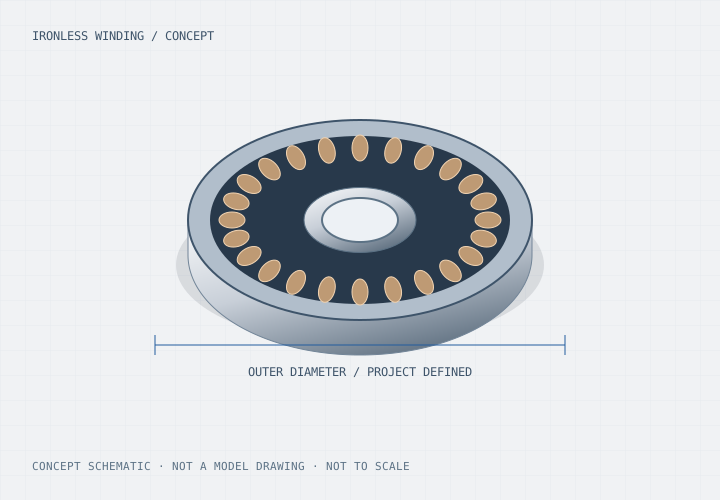
Before selecting a winding
Define how the ironless winding is located and supported in the air gap.
Agree the current, duty cycle and winding temperature under your mounting conditions.
Check low winding inductance against the selected current controller.
Removing teeth from the active winding region removes the corresponding slot-related cogging mechanism. Bearings, imbalance, current ripple and control tuning can still produce vibration. Define a measurable low-speed motion requirement rather than assuming that coreless construction guarantees a perfect axis.
A light winding can help acceleration and backdrivability, but available torque remains bounded by current and temperature. Share the required acceleration profile, load inertia, reversing frequency and drive switching strategy. Very low inductance requires particular attention to current ripple and protection.
Review potting, winding support, thermal expansion and electrical isolation. Prototype acceptance should include resistance balance, insulation, back-EMF and temperature at the intended duty cycle. Rotor balancing and bearing drag should be assessed separately from electromagnetic cogging.
They are related descriptions but should not replace a construction drawing. Confirm the active winding, back iron, rotor topology and magnetic circuit for the proposed design.
No. Removing slot-related cogging does not remove current harmonics, commutation error, bearing effects or other vibration sources.