Bus range
Provide minimum, nominal and maximum battery voltage, including regeneration.
48V / MOBILE PLATFORM
Keep a low chassis without losing sight of starting duty. Review a shallow motor or drive module against wheel load, bus range, ramp conditions and repeated acceleration.
Send Us Your Space Constraints ↗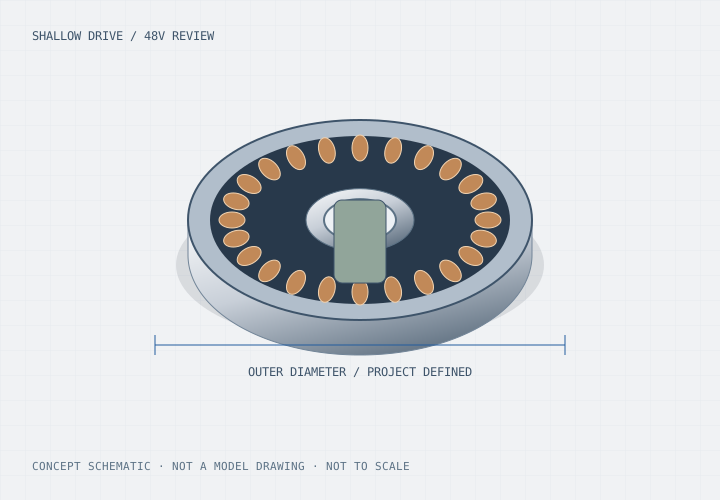
Before selecting a winding
Provide minimum, nominal and maximum battery voltage, including regeneration.
Define load, wheel radius, slope, acceleration and repeated-start frequency.
Include mounting plate, encoder, brake, connector and any gearbox.
Vehicle mass alone is not a motor specification. Wheel radius, rolling resistance, gradient and acceleration determine tractive demand. Include drive-wheel count and transmission efficiency. A low-speed motor must be evaluated for current and heating during repeated loaded starts.
Battery voltage changes with state of charge and chemistry. Provide minimum and maximum bus values, controller current, desired speed and regeneration limits. Review back-EMF at top speed and available current at low-speed operation before agreeing a winding.
Peak torque is meaningful only with a duration, starting temperature and recovery condition. Review a representative acceleration sequence and thermal test. Structural wheel loads, brake holding and emergency stopping also require explicit mechanical and system-level specifications.
A brushless motor requires a compatible controller. Voltage designation does not imply integrated control electronics.
No. Peak operation must include duration, winding temperature and recovery conditions. Continuous operation requires its own validated thermal basis.