Installed stack
Include rotor retainers, end turns, encoder and axial running clearance in your thickness budget.
FRAMELESS / EMBEDDED
Build the motor into your joint instead of building the joint around a motor. Rotor and stator kits leave bearings, housing and cable routing under your control.
Send Us Your Space Constraints ↗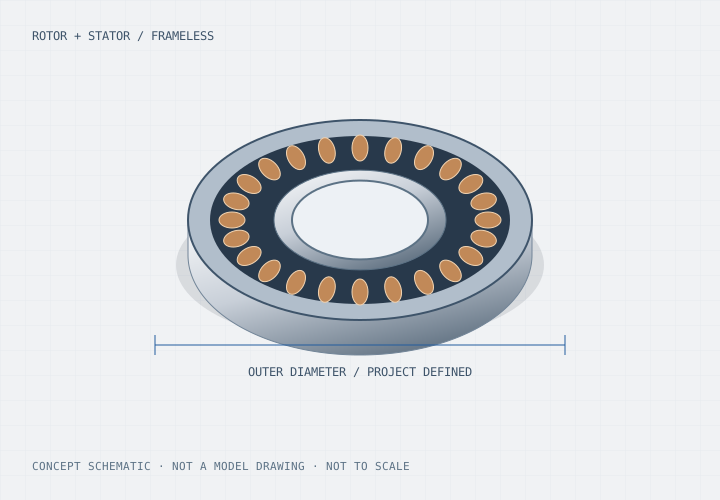
Before selecting a winding
Include rotor retainers, end turns, encoder and axial running clearance in your thickness budget.
Your bearing arrangement must control the rotor air gap under external loads.
Define how the stator transfers winding heat into your structure.
A frameless kit lets your mechanical structure support the rotor and locate the stator. That can reduce duplicated housings and bearing sets. It also transfers alignment, runout and retention responsibilities to the joint design. Start with the complete installed section, including adhesives, cable exits and encoder packaging.
Send the cable bundle diameter, connector envelope, bend radius and joint travel. A bore that clears a loose wire may still block an assembled connector or abrade a moving harness. Agree the usable passage after sleeves, retention features and seals are installed.
A motor-only torque figure does not establish joint performance. The housing material, stator fit and contact area determine heat removal. Prototype review should include winding temperature at duty, phase resistance, back-EMF, loaded runout and low-speed torque ripple. Acceptance limits belong on the agreed test plan.
Frameless denotes a rotor and stator integration scope. Bearings, encoder, brake and retention parts must be specified separately in the project drawing and quotation.
They can be reviewed together. A larger passage changes the available magnetic and winding space; feasibility requires geometry, voltage, speed and thermal information.