BRUSHED PMDC / INDUSTRIAL DUTY AND SERVICE
Pancake DC motors for industrial brushed drives.
Evaluate a brushed permanent-magnet flat motor around its armature, current control, shaft interfaces and maintenance access. Keep a new OEM motor decision separate from replacing an identified machine motor.
Is this a new brushed drive or an existing machine to retain?
This page owns the industrial brushed PMDC family decision. DC power can also feed an electronic BLDC drive, so identify the intended commutation and machine boundary before selecting a motor.
| Starting point | Bring to the review | Correct decision route |
|---|---|---|
| New industrial mechanism | Installed dimensions, duty, drive and planned brush access | Review a brushed pancake motor construction and interfaces. |
| Existing motor and amplifier | Full model/suffix, nameplate, shaft/flange, wiring and symptoms | Start the legacy-machine assessment; geometry alone does not establish an equivalent. |
| No access for brush service | Required service interval, environment and access constraints | Compare a housed brushless architecture before committing the enclosure. |
| Precision controlled motion | Load, feedback, controller and error/settling requirements | Add the complete servo-axis responsibility review. |
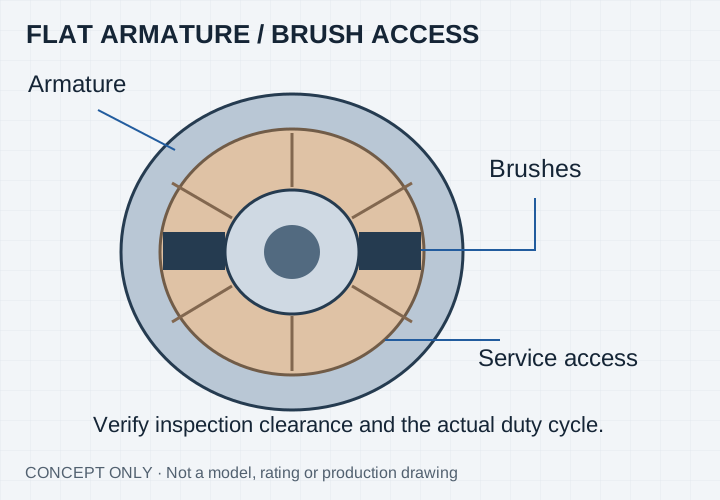
Check armature construction and the brush-maintenance boundary
A printed or ironless armature is one possible brushed pancake construction. Do not infer its cogging, inertia or thermal behavior from a thin housing alone.
| Construction / interface | What to identify | Why it changes the request |
|---|---|---|
| Armature and magnetic circuit | Actual construction, winding variant and supported speed/torque conditions | Avoid copying another series’ behavior into an unverified motor. |
| Brush and commutator | Brush system, duty, inspection route and replacement procedure | Reserve access and validate a service plan for the application. |
| Shaft, flange and bearings | Pilot, fasteners, projection, load support and alignment | Scope the full installed package and retained machine parts. |
| Tachometer / encoder / brake | Function, signal, location, mounting and cable exit | Preserve drive/feedback compatibility and the total depth. |
Engineering reference: PMW: brushed pancake construction and interface options. This establishes general context, not a PancakeMotors rating or supplied component.
Specify armature current, peak time and the installed heat path
Provide the intended DC bus range, controller model, current-limit convention, required speed and continuous/peak load timing. Include reversal, regeneration or stalled intervals that belong to the operating cycle.
Ask the motor and drive suppliers to confirm the electrical parameters and current behavior for the selected armature. A power or voltage label alone does not establish the requested duty.
Request thermal and operating evidence for the actual mounting and enclosure. Avoid using a no-load speed, peak torque headline or a different winding’s record as the continuous-duty rating.
Validate brush access against speed, load and the allowed environment
Define how a technician can inspect or replace the wear components without dismantling unrelated machine hardware. Record any contamination, exposure or maintenance restrictions before the motor is integrated.
Portescap identifies operating speed as a factor in brush/commutator wear. A service interval therefore needs application-specific evidence; a generic lifetime figure cannot be transferred to an unspecified pancake motor.
If the planned machine cannot accommodate brush inspection or the required environment excludes the proposed construction, compare a brushless review or change the installation boundary. Do not remove the service requirement simply to preserve a thin motor-only dimension.
Engineering reference: Portescap: operating speed and brush/commutator wear. This establishes general context, not a PancakeMotors rating or supplied component.
What must be agreed before a brushed motor order?
Link the winding and armature to a drawing revision, drive definition, continuous operating point and service plan. For a retained machine, document the exact original identification and acceptance interfaces first.
Agree dimensional inspection, direction/feedback checks, calibrated current capture, loaded torque-speed/thermal tests and brush inspection before and after the intended duty. These are proposed verification topics, not a report of tests already performed.
The current catalogue has no approved model rows. Send known requirements or Need advice to scope a configuration review. Supply scope, price, quantities, sample schedule and any existing-machine compatibility require confirmation in writing.
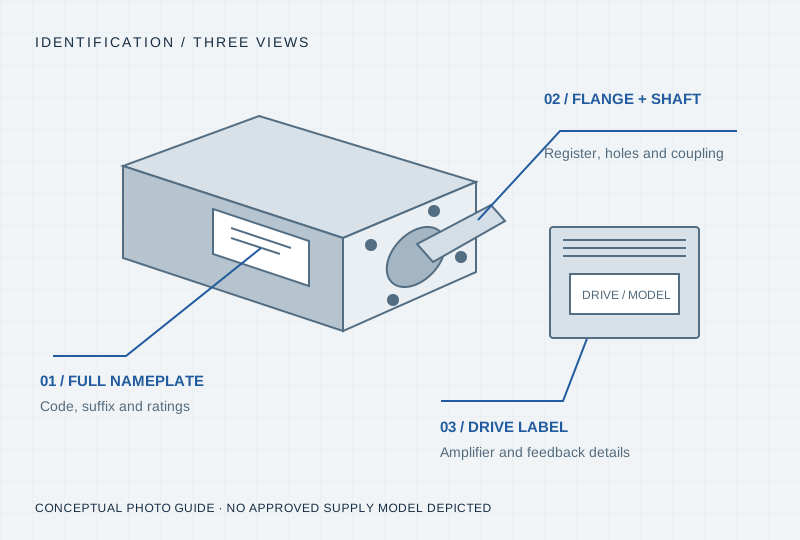
Keep an existing machine’s full motor identity.
A one-unit industrial maintenance request can begin with the nameplate. Use the replacement mode to retain the model/suffix, amplifier and mechanical interfaces; a new-motor request uses the brushed DC pack below.
Send Full Nameplate for Review ↗Your inputs / an actionable review
Prepare the industrial brushed pancake dc motor brief.
Enter known constraints or “Need advice”. Mark documents you can provide; this records availability, not file inspection or engineering approval. No document is required to start a discussion.
4 document topics to discuss. Selected documents have not been uploaded or reviewed.
Carry This Brief into the Web Inquiry ↗Your email, already structured
Prepare your engineering brief
Use the same brief in your email client or copy it with our address. Add photos or drawings as email attachments when available.
Downloads contain your entered details and file links, including contact details when provided. Keep or share them according to your project’s confidentiality requirements. Saving a draft does not send it to us. The JSON restores the inquiry form; it is not a CAD attachment.
Read or select the complete technical brief
Your inputs remain in this page until you send the web form. If your email app omits a long message, copy the complete brief above.
Brushed DC duty, service and legacy questions
Does pancake DC motor always mean a brushed motor?
Searches use the phrase in several ways. This page specifically covers industrial brushed permanent-magnet pancake motors. If the intended motor uses electronic commutation, use the brushless family review and define its controller boundary.
Are all brushed pancake motors printed-armature or ironless?
Do not assume a construction from the package name. Record the actual armature and winding design. PMW documents printed, ironless brushed families, but that does not establish the construction or rating of an unspecified PancakeMotors configuration.
Can a brushed pancake motor be used in a servo system?
A suitable brushed motor can be part of a controlled axis with compatible drive and feedback. Specify the required motion, load, measurement and commissioning scope through the servo-axis review.
What brush life or inspection interval is available?
No generic life is promised here. Provide speed, load timing, environment and maintenance access so a suitable brush system, inspection plan and validation method can be reviewed.
Can you replace my existing motor from its dimensions?
Dimensions are only one part of the assessment. Send the full nameplate and suffix, original drive/feedback, shaft/flange and operating details through the legacy review. No drop-in match is inferred from this page.
Can I begin with a single industrial maintenance unit?
Use the legacy assessment route for one-unit equipment MRO and provide the original identification. For a new brushed motor, give prototype and expected production quantities when known. Availability, price and schedule are confirmed after review.
Compare the next motor or machine integration decision.
Engineering scope reviewed 24 October 2026. Operator: Magatom Dynamics. Requested configuration and evidence are reviewed before a model, supply scope or commercial commitment is confirmed.